 LOCAL FIT KUMANOBack to list
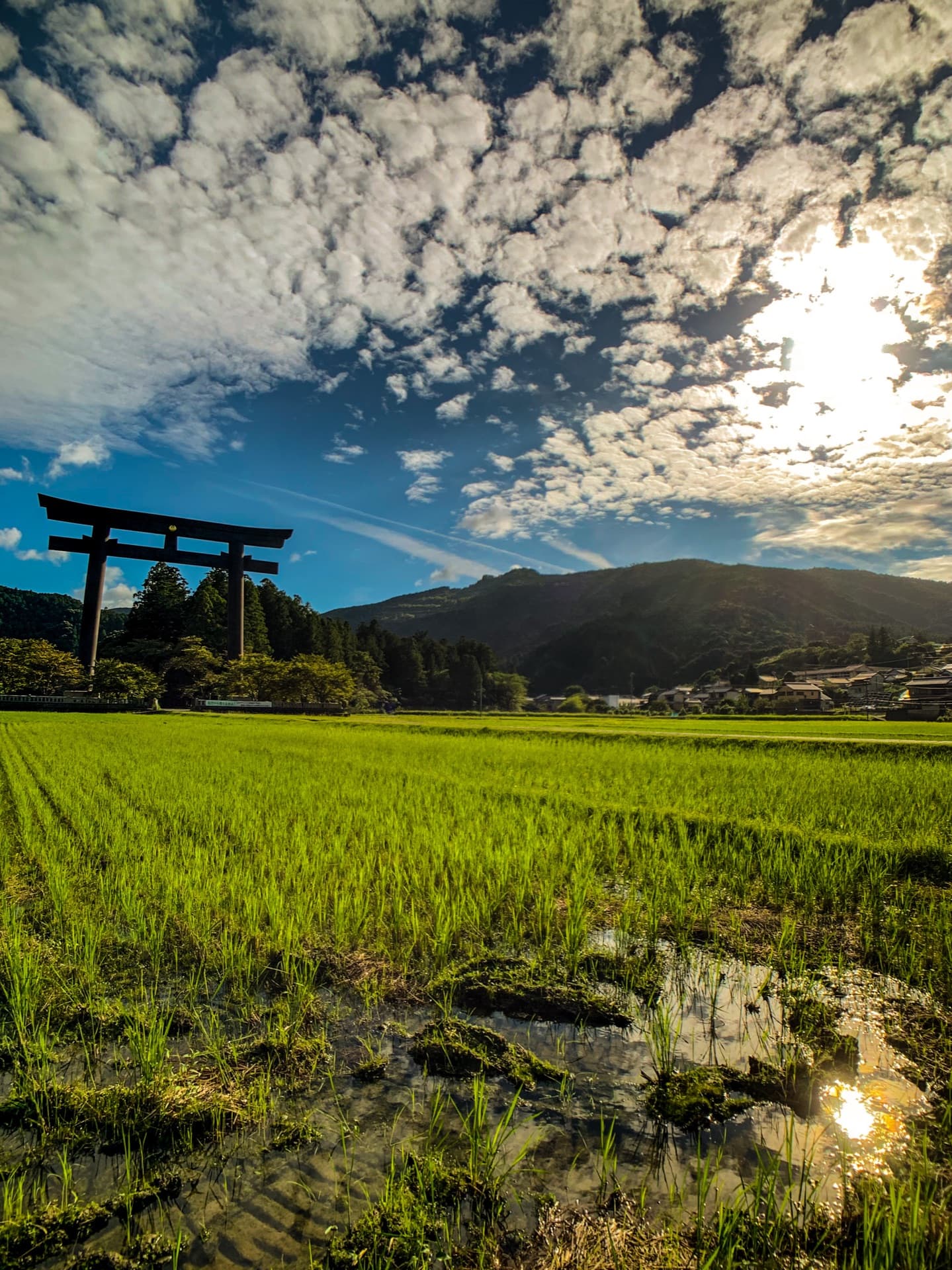
At Oyunohara, the former site of Kumano Hongu Taisha, stands a massive torii gate visible from far away. Many people who search for "Oyunohara Great Torii" are likely drawn by the wish to see with their own eyes the figure they've glimpsed in photographs.
This torii shows three completely different faces depending on your distance: viewed from afar, approached along the path, and looked up at from directly beneath. Before reaching for your camera, here is a guide to savoring the gate slowly with your own eyes.
About the Great Torii of Oyunohara
The Great Torii is a steel gate standing at the entrance to the former shrine grounds, a short distance from the current main hall of Kumano Hongu Taisha. At approximately 34 meters tall, it is known as one of the largest torii in Japan. Built relatively recently, in the year 2000, its silhouette set against the Kumano forest has become the symbol of Oyunohara.
Oyunohara was once the site where the main halls of Kumano Hongu stood in a row. After the great flood of the Meiji era, most of the shrine buildings were relocated to higher ground where they stand today. There are no shrine halls beyond the torii now, but for that very reason, it is a place where you can quietly sense the presence of "what was once a sacred site here."
Far View: Gazing at the Gate Standing Alone Across the Fields
As you make your way toward Oyunohara, the Great Torii is the first thing to catch your eye. Because there are few tall buildings around, you can clearly see it standing proudly against the sky even from a distance.
My recommendation here is to slow your pace a little. Viewed together with the surrounding fields and villages, you'll notice how the torii blends in as "part of the landscape." The depth of the surrounding greenery and the color of the sky change with the seasons, so even the same torii should take on a different expression each time.
Mid View: Walking the Approach and Pausing "Before You Pass Through"
As you get closer, the torii suddenly feels enormous. The pillars that appeared slender from afar become overwhelming in their presence up close.
Stopping briefly in front of the gate and giving a slight bow before passing through is the way of walking closest to the local sensibility. There's no need to think of it as strict etiquette, but simply by shifting your mindset to "from here on is the former shrine grounds," the time that follows takes on a deeper quality.
Up Close: From Beneath the Torii to the Forest and Stone Shrines
After passing through the torii, a stone-paved path leads into the forest. Turning back to look up at the gate, you can truly feel the thickness of the pillars and the vast opening against the sky. Unlike the distant view, the torii should have transformed from "something to look at" into "a gate to pass through."
Deeper within the grounds, stone shrines are enshrined as reminders of the former halls. The contrast between the sheer size of the Great Torii and the quiet composure of the forest is a flavor unique to this place.
A Few Small Tips for Your Walk
- Parts of the approach are gravel or dirt, so comfortable walking shoes are reassuring
- Taking several photos of the torii from far, mid, and close-up distances leaves a record of its transformation
- Appearance changes greatly with the time of day and weather, so allowing some extra time makes the visit more enjoyable
- For the latest access information and opening conditions, it's best to check official sources before your visit
In Closing
The Great Torii of Oyunohara is a curious presence whose impression changes with the distance from which you view it. Gaze at it blending into the landscape from afar, approach to feel its scale, and pass beneath it at your feet. Simply being aware of these three stages transforms it from merely a "big torii" into something that stays in your heart as a gateway to the sacred lands of Kumano. When you visit Kumano Hongu Taisha, be sure to take your time with the path leading to this torii as well, together with the main shrine.
Image: 大斎原 (via (公社)和歌山県観光連盟)


