LOCAL FIT KUMANOBack to list
Meet the Charming "Gyuba Doji" in Nakahechi, Tanabe City
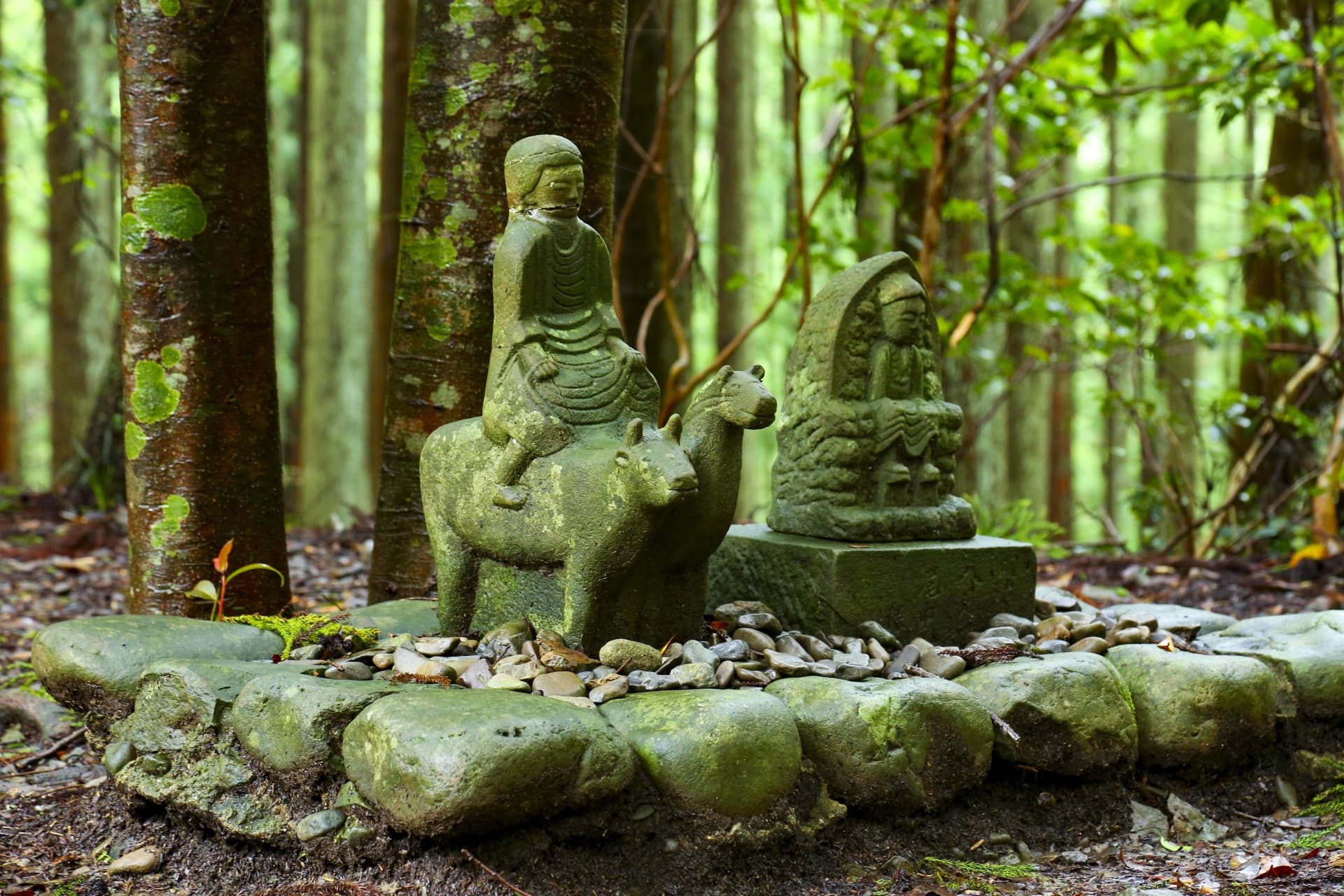
There is one photograph you'll almost certainly come across in any guidebook on the Kumano Kodo Nakahechi route: two small stone statues sitting neatly at the edge of a mountain path. These are the Gyuba Doji (literally, "ox and horse boy").
They are located in Nakahechi, Tanabe City—near Hashiori-toge Pass, up a mountain path from the village of Chikatsuyu. Tradition holds that the statues depict Emperor Kazan, who made a pilgrimage to Kumano during the Heian period. That said, the statues themselves are thought to have been carved in a relatively recent era, and there are various theories about exactly when and by whom they were made. The local way to enjoy them is not to pin down the facts, but simply to accept them as "what has been handed down."
The statues show what look like young children astride an ox and a horse, with gently gentle expressions. On a pilgrimage route a thousand years old, they add a warmth that quietly puts you at ease.
What Is "Chikatsuyu-oji," the Starting Point?
When aiming for the Gyuba Doji, a natural starting point is Chikatsuyu-oji. It is one of the "Kujukuo-oji" (ninety-nine oji shrines) scattered along the Kumano Kodo, located near the entrance to the Chikatsuyu village.
The role of the oji shrines and their broader story are also covered in our articles "What Are Oji Shrines?" and "List of the Kujukuo-oji." Chikatsuyu-oji is a perfect introductory spot for actually seeing one of these "small shrines" along the pilgrimage route in person.
- A quiet old-road atmosphere lingers in this riverside village
- Few buildings or monuments, so you can stop by in a short time
- You can sense the lingering presence of pilgrims who rested here and prayed for a safe journey
People of old, heading for Kumano Hongu Taisha, surely caught their breath here as well. Putting your hands together while imagining them helps settle your heart for the walk ahead.
From Chikatsuyu-oji to the Gyuba Doji | Walking Guide
From Chikatsuyu to Hashiori-toge Pass, the route is mostly a mountain path through cedar and cypress forest. There are no long stretches of steep rocky terrain, and it is known as one of the relatively easier sections of the Nakahechi route.
Time and Fitness Guide
Allow about 1.5 to 2 hours one way, including breaks and photo stops, to give yourself some leeway. This varies significantly with fitness level and weather, so treat it only as a rough guide.
A Half-Day Itinerary
1. Soak in the atmosphere of the Chikatsuyu village and pay your respects at Chikatsuyu-oji
2. Climb the old road toward Hashiori-toge Pass
3. Take a short break in front of the Gyuba Doji and take photos
4. Return by the same route, or continue along the next section
Whether to make a round trip or push on toward Tsugizakura-oji and the Nonaka area depends on bus schedules and your stamina. If in doubt, choose a manageable round trip and leave plenty of time for the return.
Things to Know Before You Walk
- Footwear: Slip-resistant shoes are reassuring. Wet stones and fallen leaves after rain can be surprisingly slippery.
- Drinks and snacks: It's wise to stock up before leaving Chikatsuyu.
- Transportation: Bus service can be infrequent at certain times of year. Please check the latest schedules in advance.
- Daylight: In seasons when the sun sets early, plan your departure by working backward from your return time.
Also, mobile signal can be weak on mountain paths. Saving maps in advance offers peace of mind.
What Small Stone Statues Teach Us About the Charm of Nakahechi
Nakahechi has many famous sites, from Takijiri-oji to Kumano Hongu Taisha. Among them, the Gyuba Doji stay in your memory not for grandeur but for their familiarity.
At the end of a rugged mountain path, two small children quietly wait. Standing before them, you realize that the old road is not just a hiking trail, but a path where prayer and daily life have long overlapped.
From Chikatsuyu-oji to the Gyuba Doji, in the mountain village of Nakahechi, Tanabe City—why not start with a relaxed half-day walk? As a gateway to the Kumano Kodo Nakahechi, it will surely leave a lasting impression.
Image: 熊野古道中辺路 牛馬童子 (via (公社)和歌山県観光連盟)