 LOCAL FIT KUMANOBack to list
"When is the best time to see the autumn leaves at Nachi Falls?" is a question we often get, even as locals. Let us say upfront: the autumn foliage season at Nachi Falls isn't something you can pin down on a calendar as "this is the day of peak color." The timing shifts from year to year, and the star of the scenery is a little special to begin with. In this article, we share a way of thinking about the season as a "range," along with tips on how to find the colors.
Autumn at Nachi Falls isn't the "whole mountain ablaze" type
The Nachisan area is home to many evergreen trees that stay green year-round, along with forests of tall, straight cedar and cypress. So if you come imagining a scene like the famous spots in Kyoto, where the mountainsides turn red all at once, the impression may feel a little different.
Late autumn in Kumano is really about flecks of yellow, orange, and red scattered within deep green. The white streak of the falls, the dense green, and the dotted accent colors—this "subtractive" autumn foliage is, we think, what makes Nachi distinctive.
Think of the foliage season as a "range"
As a rough guide, in many years the colors deepen through late autumn, roughly from November into December. However, because the timing shifts with the weather, rather than pinning down "this particular week," it's better to allow for a window of about one to two weeks on either side.
Guideline ① Read the elevation differences
The pace of color change isn't the same between the towns near the coast and the Nachisan area up in the mountains. In general, the higher the elevation, the stronger the chill, and the earlier the colors tend to progress. Even if the colors seem lacking in town, they may already be developing up on the mountainside.
Guideline ② Watch the chill of the year
Autumn foliage progresses faster in years with sharper morning and evening chills, and tends to be delayed in warm autumns. If you casually keep an eye on the morning temperature trend starting about a week before your trip, it becomes easier to make an educated guess.
Guideline ③ Beware after typhoons or heavy rain
Kumano is a land of frequent rain. After strong wind and rain, leaves can fall before fully coloring. Recent weather is also an important factor in reading the timing.
How to pick out the colors: look for "accents" within the green
If you're walking with autumn foliage in mind, you'll find more satisfaction by focusing on small color combinations rather than sweeping views.
- The white of the falls against the trees: the whiteness of the falling water highlights the surrounding colors.
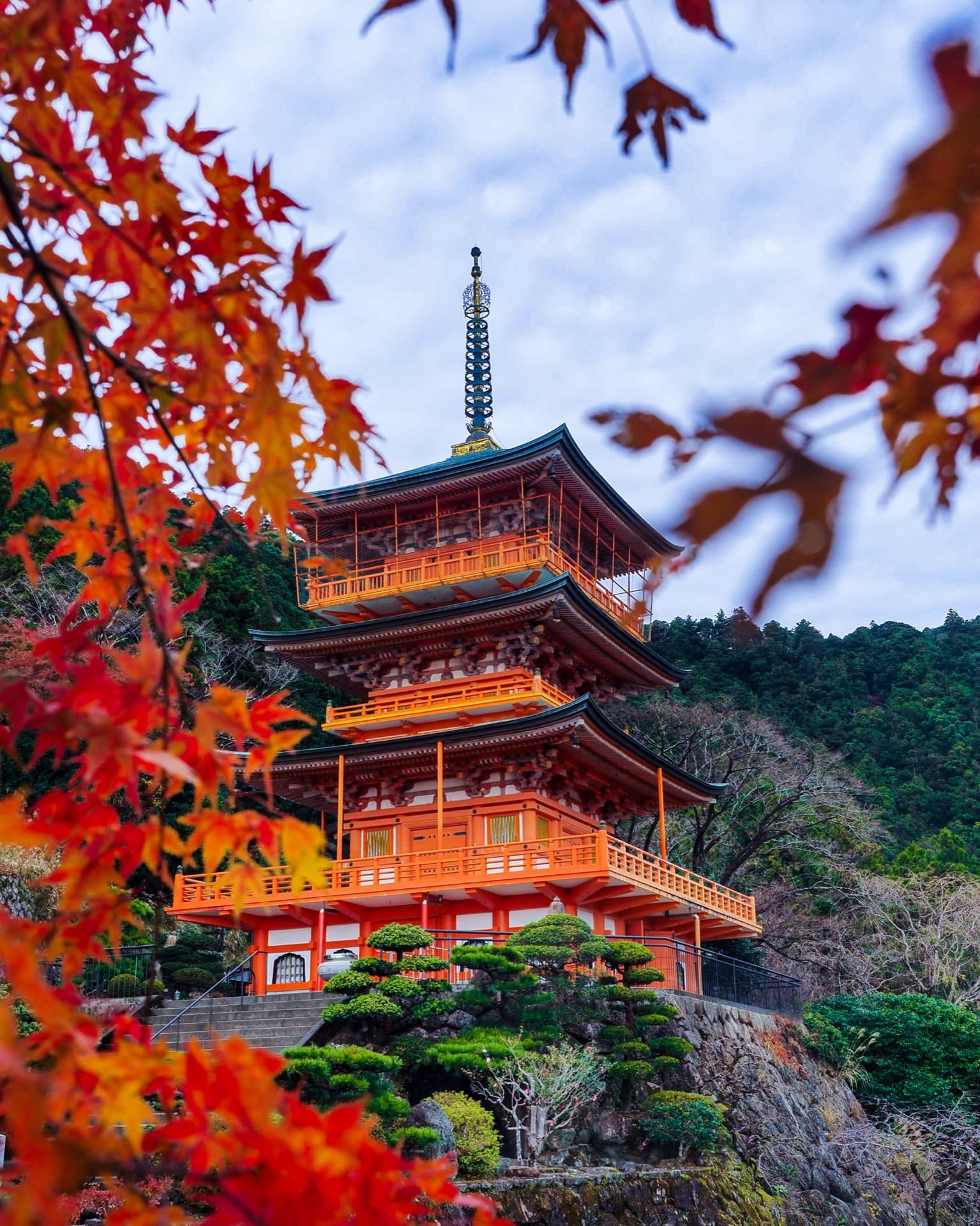
- Contrast with the vermilion shrine buildings and pagoda: the combination of green or yellow leaves with vermilion architecture is a signature sight of Nachisan.
- Fallen leaves underfoot: the leaves piled on the stone steps of the approach path and old pilgrimage trails reveal colors you can't notice by looking up alone.
In late autumn, arriving early is key
Days are short in this season, and the mountain valleys grow dark quickly in the late afternoon. The light is soft and the colors appear clearest from morning through midday. If you're after the autumn leaves, rather than rushing through late in the afternoon, it feels better to pace yourself: see the falls in the morning, and head back down with time to spare in the afternoon.
How to enjoy the day when your timing is off
There will be days when you're a bit early, or a bit late. Even so, Nachi Falls viewed in the clear autumn air carries a stillness quite different from summer. Rather than going "to see the colors," visit with the mindset of savoring the late-autumn expressions of the green mountains and the waterfall, and you'll come away satisfied on any day.
For the most current color conditions, it's reassuring to check official sources like the local tourism association before you head out. Rather than "nailing the peak," think of it as "somewhere within the range, meeting the colors of that day." With that spirit, give late autumn in Kumano a walk.
Image: 那智山青岸渡寺 三重塔 紅葉 (via (公社)和歌山県観光連盟)