 LOCAL FIT KUMANOBack to list
What to Know First When Looking for the Oyunohara Goshuin
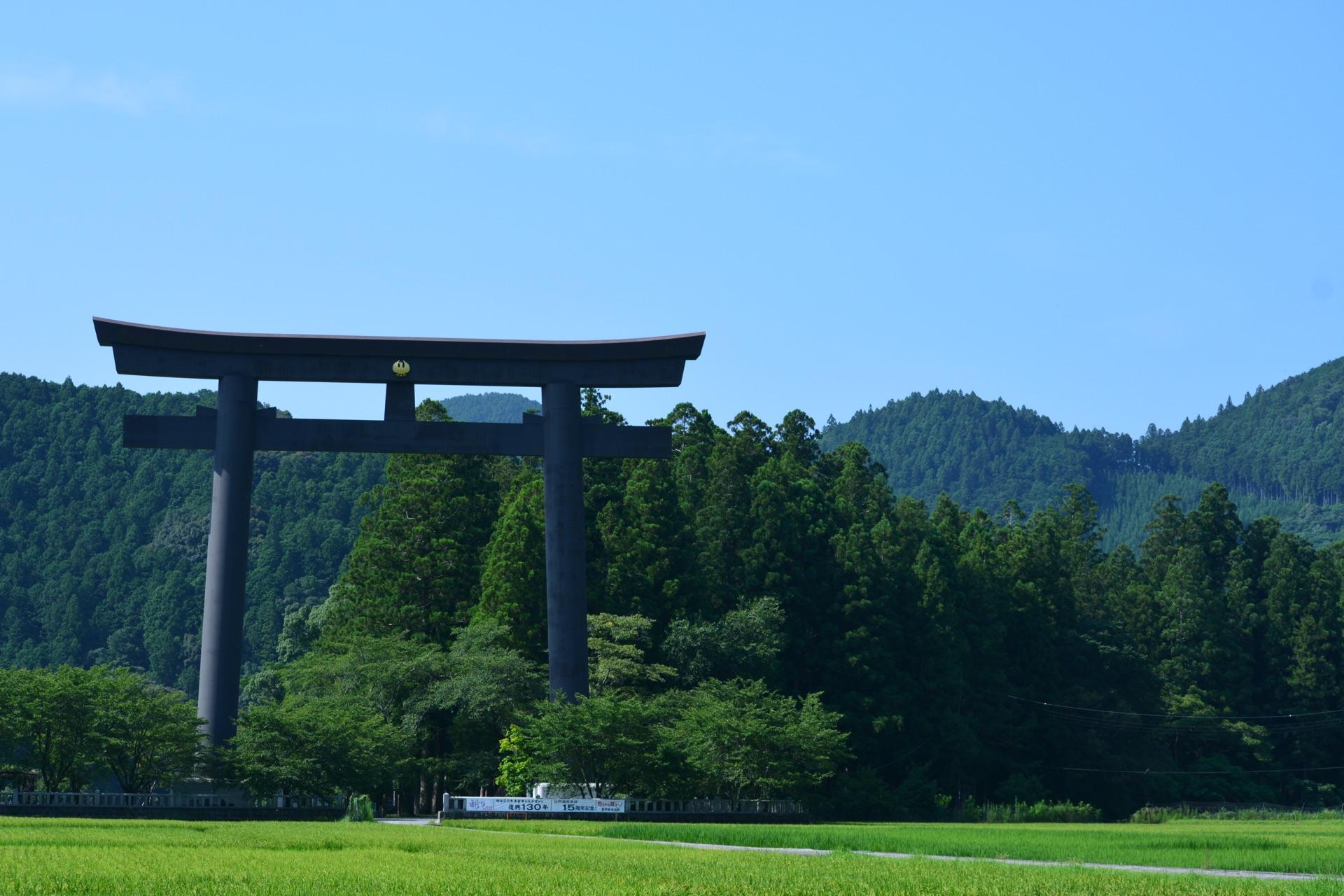
Many visitors to Kumano Hongu Taisha also make their way to Oyunohara, the site marked by a massive torii gate rising beyond the rice fields. Seeing it, quite a few travelers wonder, "Can I get a goshuin here too?"
The short answer is this: Oyunohara is not a place where a shrine hall stands today, but rather the former grounds of Kumano Hongu Taisha. For that reason, the basic approach is to inquire about the goshuin at Kumano Hongu Taisha itself. Since the location and details of how goshuin are offered may change, please check the official information or the notices on-site for the latest details.
Oyunohara Is Where the "Former Hongu" Once Stood
Oyunohara is a quiet grove spreading across a sandbar where three rivers—the Kumano, the Otonashi, and the Iwata—converge. The halls of the original Kumano Hongu once stood here. In the great flood of 1889 (Meiji 22), most of the shrine buildings were washed away, and the shrine was later relocated to its current site on higher ground.
Today at Oyunohara, small stone shrines dedicated to the Kami-yon-sha and Naka-yon-sha—those that survived the flood—remain enshrined. At the entrance stands a great torii gate said to be about 34 meters tall. Precisely because this wide space has no shrine halls, it is a place where the atmosphere of the former sacred ground can be felt all the more clearly.
The Easiest Route: "Hongu Taisha → Oyunohara"
If receiving a goshuin is part of your plan, the following flow makes for a smooth visit.
1. Visit Kumano Hongu Taisha First
Climb the stone steps to the main hall. When receiving a goshuin, it is standard etiquette to complete your worship first, then inquire at the shrine office.
2. Then Walk to Oyunohara
From Hongu Taisha, you can walk to Oyunohara along a path through the countryside. Strolling there after your visit, you'll truly sense that "the hall I just climbed up to was originally on that sandbar."
3. Pass Through the Great Torii and Pay Respects at the Stone Shrines
Since there are no main halls, the quiet time you spend offering your prayers is itself the act of worship at Oyunohara.
Preparing Your Goshuincho and Points to Keep in Mind
- Don't forget your goshuincho: Pre-written versions may be available, but having your own book keeps your travel memories together.
- Bring small change: Having coins on hand helps ensure no change is needed for the offering.
- Worship first, goshuin second: A goshuin is proof of your worship. Following this order allows you to receive it with a clear heart.
- Allow extra time during busy periods: Weekends and holidays can mean waiting, so leave yourself a buffer before your return bus.
- Keep photography and walking at Oyunohara quiet: Be mindful that this is a place of prayer—watch your voice level and where you step.
A Goshuin Becomes a Keepsake of Your Journey's Path
The goshuin you receive at Kumano Hongu Taisha holds the memory of your visit to the hall on the high ground. When layered with the experience of passing through the great torii of Oyunohara, that single piece of calligraphy becomes a signpost connecting "the shrine of today" with "the sacred ground of old."
In the mountains of Kumano, time flows slowly. Rather than getting too caught up in the procedure of receiving a goshuin, try to take home with you the sound of the river breeze and the stillness of the grove as well.
Image: 大斎原 (via (公社)和歌山県観光連盟)


