 LOCAL FIT KUMANOBack to list
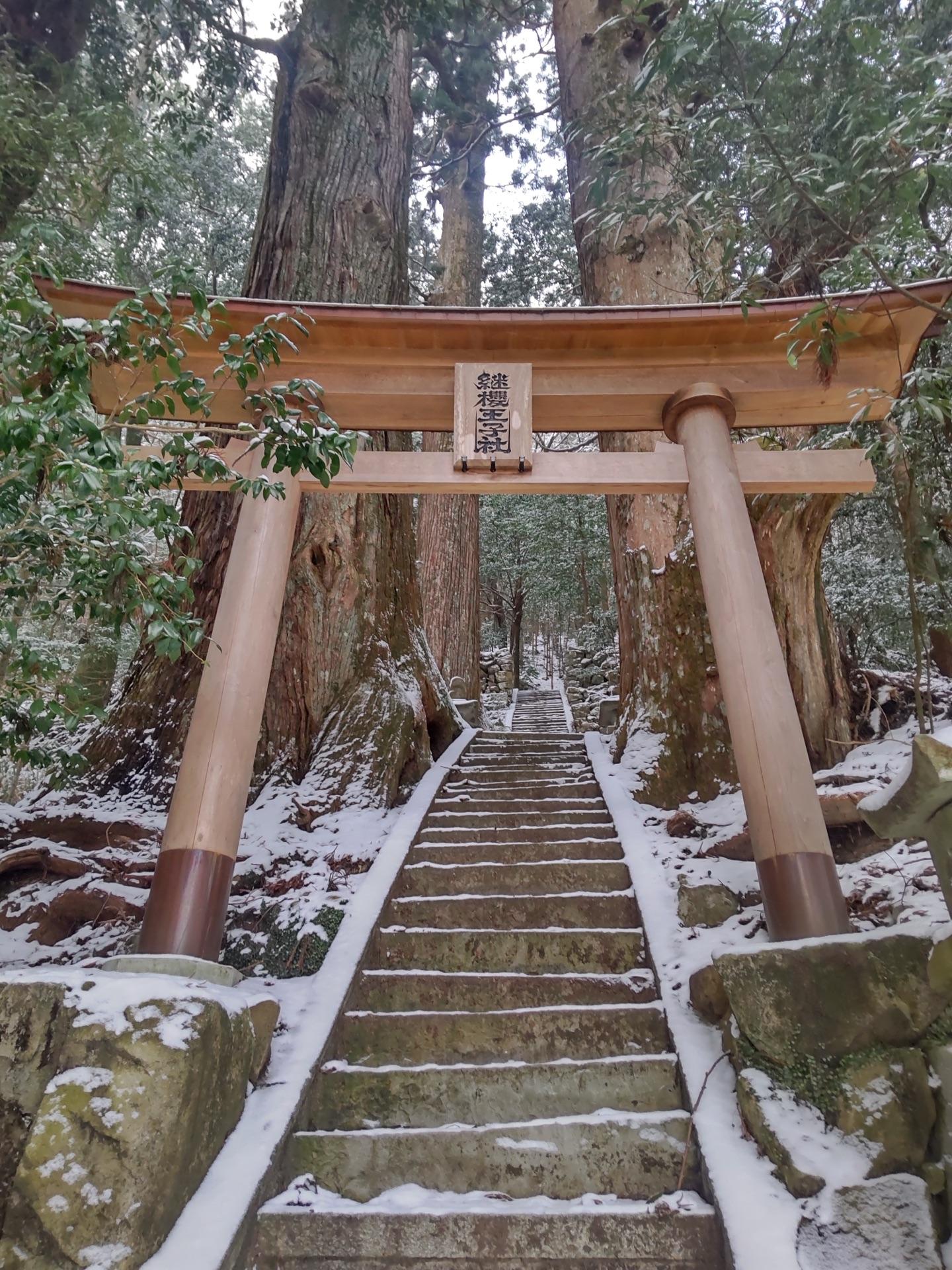
Giant Cedars in a Mountain Village, Their Branches All Facing One Way
Walking the Nakahechi route of the Kumano Kodo, you sometimes emerge from a mountain pass to find a village suddenly opening before you. Nonaka, in Nakahechi-cho, Tanabe City, is one such village. Here, a cluster of giant cedars called the "Nonaka Ippo-sugi" (Nonaka's One-Direction Cedars) stand within the precincts of Tsugizakura-oji.
The word "ippo" ("one direction") in the name comes from the way the cedar branches all reach out in a single direction. Look up, and you'll see that the thick branches growing from each trunk all point toward the same side. Cedars normally spread their branches in all four directions, so this difference feels increasingly strange the more you take in each tree one by one.
Why "One Direction"? | Reading the Legends
Local tradition holds that the branches of these cedars stretch toward Kumano Hongu Taisha — as if welcoming pilgrims and, at the same time, paying reverence to the Grand Shrine. There are also explanations that point to natural causes for this phenomenon, such as sunlight, wind direction, and the relationships with surrounding trees.
The real reason cannot be stated with certainty. Still, knowing that along this pilgrimage route they have long been called "trees that face the gods," and then looking up at them, you begin to see them as something more than just large trees. These ancient trees are said to be several hundred years old — some accounts put them at around 800 years — and they are protected as a Natural Monument.
Pausing at Tsugizakura-oji
Beside the Ippo-sugi stands Tsugizakura-oji. The "oji" shrines scattered along the Kumano Kodo are small shrines enshrining the child deities of the Kumano gods, and they served as places where pilgrims offered prayers and rested.
As for the origin of the name, a legend remains that connects it to Fujiwara no Hidehira of Oshu. The story goes that on his pilgrimage he thrust his cherry walking stick into the ground, and it took root and grew. From a cherry walking stick to giant cedars, the precincts layer story upon story of "trees."
Tips for Looking Up
- First, take in the thickness of the trunks: Stand at the base, and even a person's height feels small in comparison.
- Next, follow the direction of the branches: Compare several trees to see which way the branches extend.
- Finally, look up at the sky: Enjoy the cedar tops against the blue sky — and, depending on the season, the colors of moss and dappled sunlight too.
Nearby Water, and Before and After Your Walk
Nonaka is also known for a spring called "Nonaka no Shimizu." Said to have quenched travelers' thirst since ancient times, it is sometimes listed among Japan's famous waters. Whether it is suitable for drinking can vary depending on conditions, so it's best to check the signs and local information on site before enjoying it.
The road from the village of Chikatsuyu toward Nonaka mostly passes through calm stretches of satoyama fields and small settlements. Still, it is a mountain road.
- Stones and soil can be slippery after rain, so wear shoes with firm soles
- Allow plenty of time for the weather and sunset
- Since this is a place where villagers live, walk quietly
More Than a "Major Sight" — Time to Pause
The Nonaka Ippo-sugi is not a flashy spectacle. Its appeal lies in being able to stand in the same spot where travelers of the ancient road have paused for hundreds of years. Catch your breath beneath the cedars and imagine where their branches point. Those few minutes will quietly remain in your memory of the Nakahechi journey.
Before setting out, check the latest road and trail conditions, and plan a visit that doesn't push your limits.
Image: 熊野古道中辺路 継桜王子 (via (公社)和歌山県観光連盟)


