 LOCAL FIT KUMANOBack to list
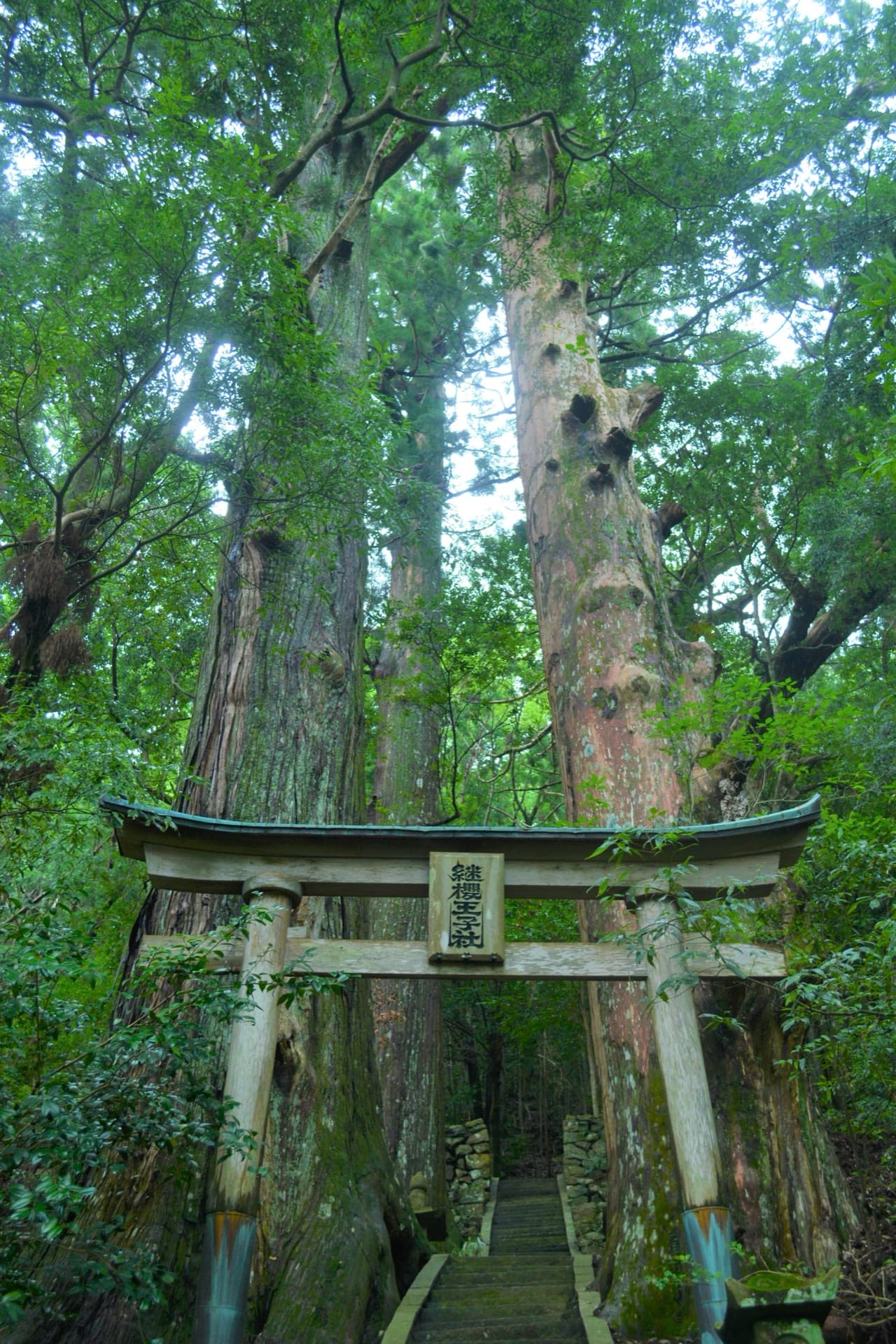
A Mysterious Cedar Grove Where Branches All Reach the Same Way
Walking the Nakahechi route of the Kumano Kodo, you'll find places where the mountain path suddenly opens up into a peaceful village. Nonaka, in Nakahechi-cho, Tanabe City, is one of them.
It sits along the road that continues from the village of Chikatsuyu—known for the Gyuba Doji statue—and within the grounds of Tsugizakura-oji shrine here, the 'Nonaka no Ippo-sugi' (the one-direction cedars) stand out above all else.
The Origin of the Name 'Ippo-sugi'
As the name suggests, the branches of these great cedars all stretch from the trunk in the same direction.
Local tradition holds that the branches reach toward the direction of Kumano Hongu Taisha—as if welcoming pilgrims, or as if the trees themselves are paying their respects to Hongu. A scientific explanation cannot be confirmed, but looking up with this story in mind, you may feel that even these giant trees have their own 'direction of prayer.'
The Ippo-sugi are said to be designated as a Natural Monument of Japan. Beyond the sheer thickness and height of the trunks, viewing their branching from the side is far more striking than any photograph can convey.
Tsugizakura-oji and the Story of the Cherry Tree
There is also a small story behind the name 'Tsugizakura' (literally, 'grafted cherry').
According to legend, when Fujiwara no Hidehira of the Oshu region died in this area during his pilgrimage to Kumano, a cherry staff was planted here as a memorial—and this is said to be the origin of the name. The details vary among different accounts, but the sight of a cherry tree standing close beside the great cedars is sometimes cited as the source of the name.
Searching for 'which tree is the cherry?' as you walk is another way to enjoy the site throughout the seasons.
A Pause at the Nonaka Spring
In the village of Nonaka, there is a spring long beloved by locals: the Nonaka no Shimizu (Nonaka Spring). Selected by the Ministry of the Environment as one of Japan's '100 Famous Waters,' it has quenched the thirst of travelers walking the old road for centuries.
For the latest information on whether the water can be drunk or how to draw it, please check the on-site signage or the local tourism association before enjoying it.
Tips for the Walk
- From Chikatsuyu to Nonaka: Connecting your walk from around the Gyuba Doji area, the satoyama countryside scenery continues, and the Ippo-sugi appear like a 'reward' at the end.
- The order of looking up: First take in the overall shape from a distance, then approach to feel the texture of the trunks, and finally check the direction of the branches—each view reveals something different.
- Seasonal notes: In the fresh green of early summer, the light is soft; in winter, the deep green of the cedars and the stillness stand out.
- Underfoot: You'll encounter a mix of paved village roads and earthen mountain paths. It can be slippery after rain, so well-worn walking shoes are recommended.
Editor's Note
When we think of the Kumano Kodo, our attention tends to turn to stone-paved paths and mountain pass views. But places like Nonaka—'great trees and water along the way in a village'—are the kind of spots that ease the hearts of those who walk.
As you check the direction of the branches, try to imagine the feelings of the people heading toward Hongu. Pausing and lingering here is one way to savor Kumano.
※ Opening conditions and the state of surrounding roads may change. Before heading out, please check the latest information from the local municipality or tourism association.
Image: 熊野古道中辺路 継桜王子 (via (公社)和歌山県観光連盟)


