 LOCAL FIT KUMANOBack to list
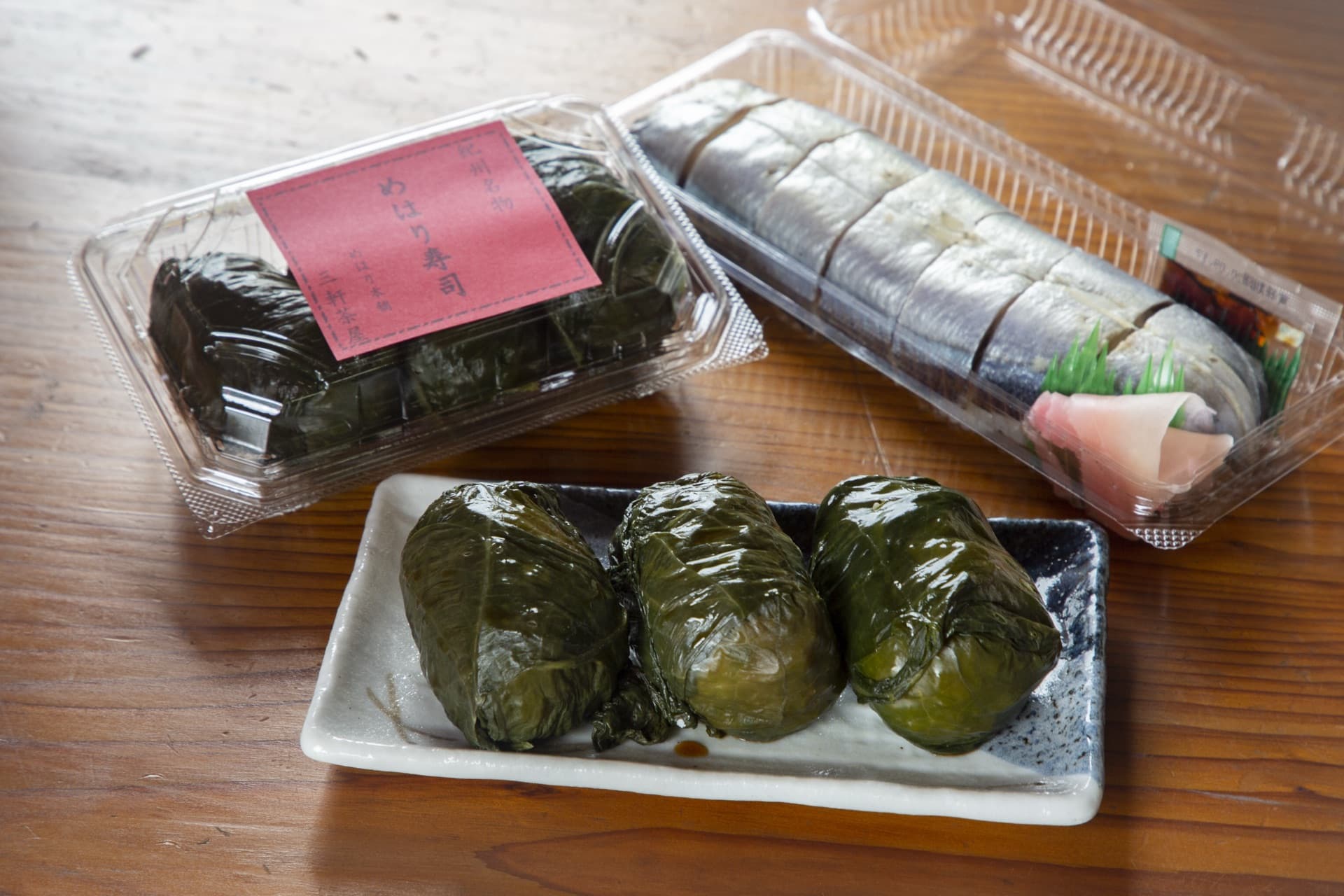
Kumano's 'Sushi' Changes Character Depending on the Travel Scene
When people hear 'sushi' in Kumano, many may picture eating nigiri at a counter. But this region also has humble local sushi that grew out of everyday life. The two most representative examples are mehari-zushi and sanma-zushi.
Even though they share the name 'sushi,' their character differs greatly between a day walking mountain trails and a meal enjoyed in a seaside town. In this article, we introduce how to enjoy the two by matching them to different moments of your journey.
Mehari-zushi | A 'Fueling Up' for Mountain Work and the Old Pilgrimage Trails
Rice Wrapped in Takana Leaves
Mehari-zushi is a large rice ball-like sushi, with rice wrapped in salt-pickled takana (mustard greens) leaves. Unassuming in appearance, it sits heavily in the palm of your hand. The mild saltiness and subtle tang of the takana bring out the flavor of the rice, and despite its simplicity, it's hard to stop eating.
The name is said to come from how you open your eyes wide (me o miharu) as you take a big bite, though there are several theories about its true origin. Recalling these stories as you bite in is part of the fun.
Why It's Perfect for a Day on the Old Trails
Because it's wrapped in leaves, your hands stay clean and it's easy to carry. It's a perfect lunch for a day walking the Kumano Kodo.
- Unwrap and enjoy at a mountain pass rest area or in the shade of a tree
- The saltiness is welcome when your body has worked up a sweat
- The rice takes on the flavor of the takana, and the taste holds up even when cold
Some inns and town shops carry it, so it's a good idea to check the day before.
Sanma-zushi | A Taste That Brings Back the Kumano-nada Sea
Vinegar-cured Pacific Saury
Sanma-zushi is a bar-shaped sushi made by splitting open a Pacific saury (sanma), curing it in vinegar, and shaping it over rice. Around Shingu and Nachi-Katsuura, which face the Kumano-nada sea, it has long been a familiar home-style dish. The balance of vinegar and the fish's natural oils blends well with the rice.
Paired with the Air of a Port Town
This one is best savored slowly while looking out at the sea. After visiting Nachisan or Hongu, return to a coastal town and enjoy it with tea—the fatigue of travel seems to melt away. The preparation, size, and seasoning vary by shop and household, making tasting comparisons part of the fun.
How to Work the Two Sushi into a Day of Travel
| Scene | Recommended Sushi | Reason |
|---|---|---|
| Lunch on a day walking the old trails | Mehari-zushi | Easy to hold, with pleasant saltiness |
| Evening in a port town after walking | Sanma-zushi | Savor the scent of the sea at a relaxed pace |
Things to Know Before Eating
- Availability and seasons vary by shop and inn. If there's a day you really want to try one, check ahead to be sure.
- Local foods are sometimes limited in quantity due to preparation. Ask whether reservations are possible.
- When eating on the old trails, always carry out your wrappers and any trash.
In Closing
The charm of Kumano is that the mountains have their sushi and the sea has its own. Lighten the first steps of your trail walk with mehari-zushi, and cap off a seaside evening with sanma-zushi. By choosing between the two, you can taste the land of Kumano bite by bite.
Image: めはり寿司とさんま寿司 (via (公社)和歌山県観光連盟)


