 LOCAL FIT KUMANOBack to list
One More Thing to Know After Checking the Time Required
Many people search for "Gotobiki Rock time required," which tells us it's an easy place to fit into an itinerary. We'll leave the question of time allocation to another article on this site. Here, we've put together a pre-visit guide to the background of the rock — knowledge that changes how you see it, even on a short visit.
What Does "Gotobiki" Mean?
Gotobiki is said to be a local dialect word for toad. The name is said to come from the way the massive rock sits solidly atop the mountain, resembling a toad crouching on its haunches.
When you actually look up at it, there's indeed a roundness and weight that makes you think, "Now that you mention it, maybe it does look like a toad." Just knowing the name softens the impression you get when standing before the rock.
The Rock Itself Is the Sacred Object
Gotobiki Rock stands at Kamikura Shrine on Mount Kamikura in Shingu City. Here, the rock itself has long been revered as the object of worship.
Mount Kamikura is said to be the place where the Kumano deities first descended to earth. For this reason, Kamikura Shrine is positioned as the original shrine (motomiya) of Kumano Hayatama Taisha. Walking both shrines together gives you a three-dimensional view of how Shingu came to be.
"Ama-no-Iwatate" in the Legend of Emperor Jimmu
In mythology, after Emperor Jimmu landed in Kumano, he is said to have climbed a fortress-like rock formation called Ama-no-Iwatate (the Heavenly Rock Shield). This Ama-no-Iwatate is believed to be Mount Kamikura.
When you stand before the rock, try to imagine how people of long ago felt a special power in this great rock atop the mountain. The practice of worshipping not a shrine building but the very presence of the rock itself carries on an ancient form of Kumano faith into the present.
The Stone Staircase and the Winter "Oto Matsuri"
To reach the shrine, you climb a steep staircase built of piled natural stones. According to tradition, this historic staircase was donated by Minamoto no Yoritomo. Each step varies in height and angle, so the basic rule is to climb slowly, watching your feet.
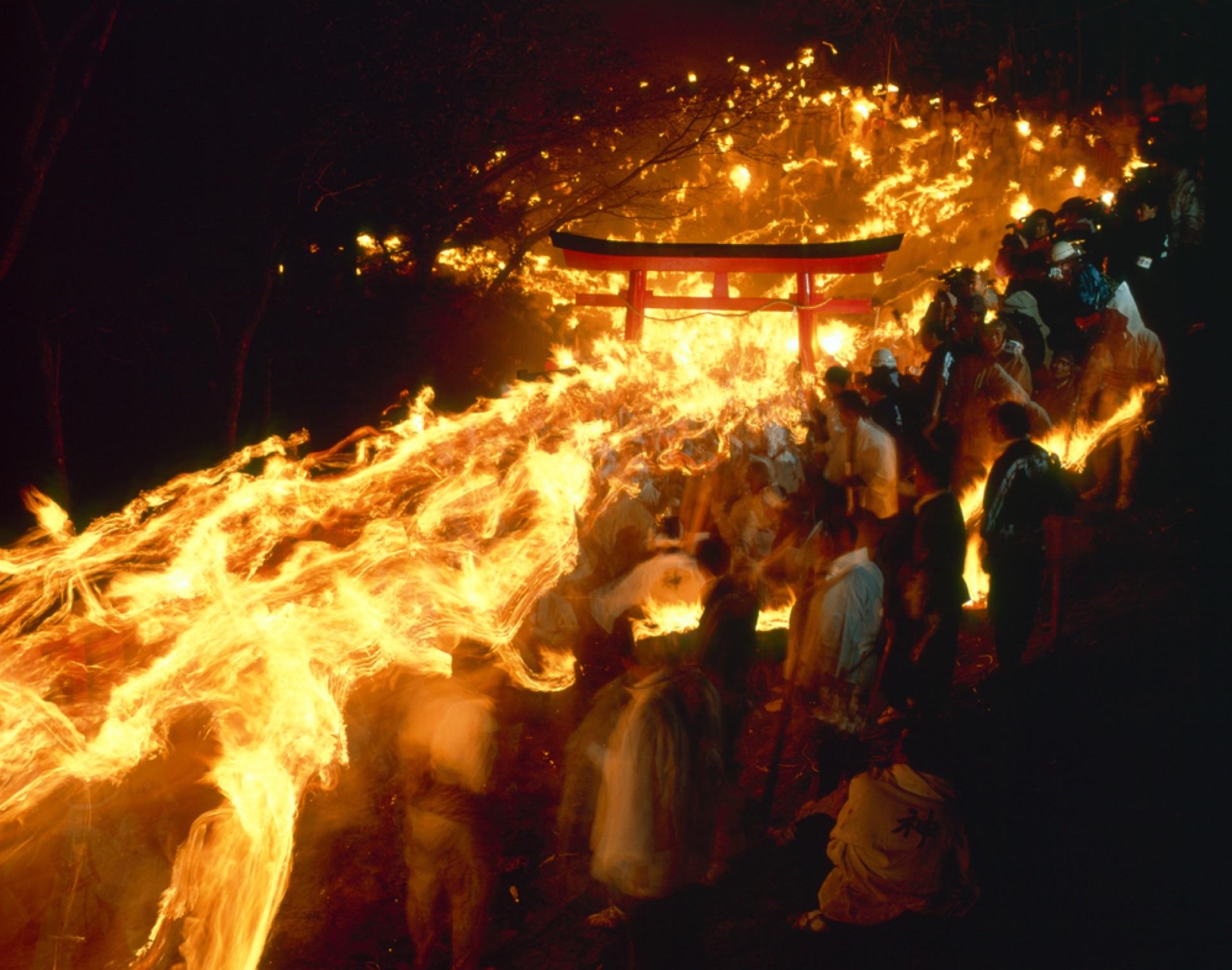
Every February, the Oto Matsuri fire festival is held, in which men in white robes race down the stone steps carrying torches. The entire mountainside is painted with streams of flame — it is one of Kumano's signature fire festivals. The usually quiet staircase transforms dramatically, just once a year. Knowing this background makes even the everyday stillness of the stone steps feel different.
Small Tips for Viewing
- Look for the toad shape: Step back a little from the front and take in the outline
- Look up from below the rock: You'll feel the scale of the rock and the power of the space beneath it
- Turn around and look at the town: The town of Shingu and the direction of the Kumano River come into view at a glance
- Wear non-slip shoes: The stone steps are especially slippery after rain
Precisely Because the Visit Is Short
Kamikura Shrine may not be a place where you linger. But once you climb knowing the origin of the name, the legend of Ama-no-Iwatate, its role as the original shrine, and the Oto Matsuri, the same stone staircase transforms into "a path that traces a story."
With the same ease as checking how long the visit takes, please take the story of the rock into your head before you set out.
Image: 神倉神社 お燈祭り (via (公社)和歌山県観光連盟)


